Chanterelle Mushrooms: Foraging Guide & Recipes
The golden chanterelle is one of the most prized finds for any forager. It has amazing yellow colour so you can’t miss it, delicate apricot aroma and firm texture, which makes it really lovely to cook with.
In this guide, I’ll take you through everything you need to know about foraging for chanterelles, from distinguishing them from their “false” look-alikes to the best ways to cook them so they retain their famous woodland flavour.
FORAGING RESOURCES
- Best foraging books to get you started with wild food >>
- Monthly Foraging Guide – What’s in season now >>

Chanterelle mushroom – common name & latin name
The chanterelle, often called the Golden Chanterelle, is scientifically known as Cantharellus cibarius. The name comes from the Greek “kantharos,” meaning “cup” or “goblet,” referring to its distinctive flared shape. In the UK, it is highly sought after for its culinary value and is considered a “choice” edible mushroom globally.
Where to find chanterelles as native fungi
Chanterelles are native to the UK, Europe, and North America. Unlike plants that grow in the soil, chanterelles are mycorrhizal, meaning they form a symbiotic relationship with the roots of specific trees. They help the tree absorb nutrients, and in return, the tree provides the mushroom with sugars. You will almost always find them near host trees like beech, birch, oak, or occasionally pine.
The main types of chanterelle mushrooms
While Cantharellus cibarius is the most famous, several related species are found in the UK:
- Golden Chanterelle (C. cibarius): The classic bright yellow, meaty mushroom.
- Winter Chanterelle (Craterellus tubaeformis): Also known as “Yellowlegs,” these are smaller, brownish on top, and appear later in the season (October–December).
- Pale Chanterelle (C. pallens): Similar to the golden variety but much paler, almost white or cream, and often stockier.
- Girolle: This is simply the French name for the golden chanterelle, often used in high-end restaurants.
Where to find chanterelles in the UK
Chanterelles prefer moist, mossy ground and well-drained, acidic soil.
- Coniferous Woodlands: Look under Scots Pine and Spruce.
- Deciduous Forests: Search near the base of old Beech and Oak trees.
- Mossy Banks: They love damp, moss-covered slopes near woodland paths.
- Highland Areas: They are particularly abundant in the damp, wooded glens of Scotland and Wales.
Growing season for chanterelles
In the UK, the chanterelle season typically begins in July and can last until the first hard frosts in late October or November. They thrive after periods of heavy rain followed by a few days of humid, warm weather. Unlike many mushrooms that rot quickly, chanterelles are slow-growing and can remain fresh on the forest floor for several weeks.
Ethical Foraging and the “Spore Trail”
To ensure that your favorite foraging spots remain productive for years to come, it is essential to practice ethical harvesting. Never clear an entire patch; follow the “50/50 rule” by leaving half of the mushrooms behind to mature and release their spores.
The container you choose for your harvest also makes a difference. Instead of using a plastic bag, which causes the mushrooms to sweat and spoil, use a wicker basket or a mesh bag. As you walk through the woods, the holes in the basket allow the microscopic spores to fall out and scatter across the forest floor, effectively “planting” future generations of chanterelles with every step you take.
MORE MUSHROOM FORAGING
- Puffball Mushrooms: The complete guide >>
- Parasol Mushrooms: Foraging Guide & Recipes >>
- Milkcap Mushrooms: Identification Guide & Recipe Ideas >>
How to identify chanterelle mushrooms
To identify a true Golden Chanterelle, look for these specific features:
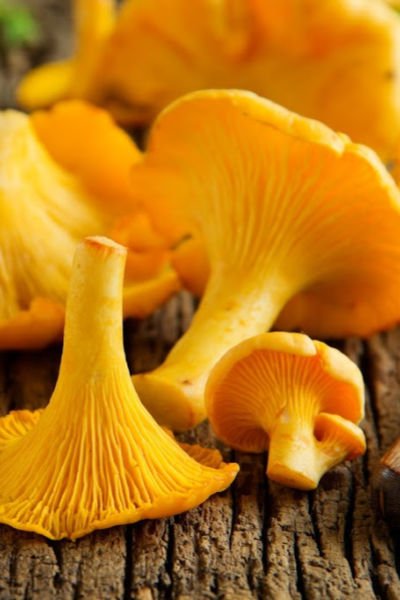
- Colour: A uniform egg-yellow to deep orange-yellow.
- Shape: Young mushrooms are convex, but they mature into a funnel or “cup” shape with wavy, irregular edges.
- Gills (The “False Gills”): This is the most important feature. Chanterelles do not have true, blade-like gills. Instead, they have shallow, blunt ridges that are “decurrent,” meaning they run down the stem. These ridges are often interconnected (forked).
- Flesh: The inside flesh is pale white to creamy yellow. When torn, it should look like the texture of a “string cheese.”
- Smell: They have a very distinct, faint aroma of fresh apricots or peaches.
The “String Cheese” Identification Test
One of the most reliable ways to confirm you have found a genuine chanterelle is to look at the internal structure of the mushroom. While the outside should be a vibrant egg-yellow, the internal flesh of a true golden chanterelle is always solid white or pale cream.
To perform this test, gently tear the stem vertically from the base upward. A real chanterelle will peel in strips, much like string cheese or a piece of cooked chicken breast. If the flesh inside is orange, yellow, or feels hollow and flimsy, you are likely looking at a false chanterelle or a poisonous Jack O’Lantern.
Are there any mushrooms that look like chanterelles?
Yes, and it is vital to know the difference. While the true chanterelle is safe, its look-alikes range from “unpleasant” to “toxic.”
- False Chanterelle (Hygrophoropsis aurantiaca)
- Difference: It has true, thin, crowded gills that are much more orange than the cap. The stem is thinner, and it lacks the apricot smell.
- Poisonous: Not deadly, but can cause hallucinations or digestive upset in some.
- Jack O’Lantern (Omphalotus olearius)
- Difference: These grow in dense clusters directly on wood or buried roots. They have true, non-forked gills.
- Poisonous: Yes. They cause severe vomiting and cramps.
- Hedgehog Mushroom (Hydnum repandum)
- Difference: Similar colour and shape, but the underside has spines (teeth) instead of ridges.
- Poisonous: No, it is a delicious edible!
Medicinal & Nutritional properties
- Vitamin D: One of the few non-animal sources of Vitamin D, particularly $D_2$.
- B-Vitamins: Rich in B3, B5, and B6.
- Iron & Copper: High in essential minerals for blood health.
- Anti-inflammatory: Contains polysaccharides that may help boost the immune system.
How to harvest chanterelles
- When: Harvest when the caps have flared out but before the edges turn brown and “melted.”
- How: Use a sharp knife to cut the mushroom at the base of the stem. Do not “pull” it out, as you want to leave the underground mycelium undisturbed.
- Cleaning: Use a soft brush to remove pine needles and dirt. Avoid washing them in water, as they act like sponges and will lose their texture.
How to store and keep chanterelles
- Refrigeration: Store in a paper bag (never plastic) in the fridge for up to a week.
- Drying: Chanterelles do not dry as well as porcini; they can become woody.
- Freezing: The best way to preserve them is to sauté them in butter first (“dry-sauté” to remove moisture), then freeze the cooked mushrooms.
The “No-Wash” Rule: How to Clean Your Harvest
One of the most common mistakes a beginner forager can make is soaking their chanterelles in a bowl of water. Mushrooms are essentially biological sponges; their porous structure will soak up water instantly, which ruins their delicate texture and dilutes their flavour.
To preserve the quality of your find, follow the “No-Wash” rule. Use a soft-bristled brush (a clean paintbrush or a dedicated mushroom brush works perfectly) to gently whisk away pine needles and soil. If you encounter stubborn grit in the ridges, use a slightly damp cloth to wipe it away.
If the mushrooms are exceptionally dirty, you can give them a very brief rinse under a cold tap immediately before cooking, but you must pat them dry with a paper towel right away. Keeping them dry ensures they will sear beautifully in the pan rather than boiling in excess water.
Adding chanterelles to your meals
- Simple Sauté: Fry in butter with a little garlic and parsley. Serve on sourdough toast.
- Risotto: Add to a creamy risotto toward the end of cooking to preserve their delicate flavour.
- Cream Sauces: They pair beautifully with cream and chicken or white fish.
- Omelets: A classic French breakfast.
The Chanterelle Taste Profile and Food Pairings
The golden chanterelle is famous for its complex, multi-layered flavour that sets it apart from the common button mushroom. Often described as having a faint aroma of fresh apricots or peaches, its taste is earthy and peppery with a delicate, fruity undertone. The texture is equally important; when cooked correctly, it remains firm and “meaty” rather than becoming soft.
Because of these unique notes, chanterelles pair exquisitely with ingredients that complement their fruitiness or ground their earthiness. They are a natural match for hazelnuts, thyme, and shallots, and they shine when paired with fatty elements like heavy cream, butter, or soft cheeses. For a main course, they are the traditional accompaniment to wild game, roasted chicken, or flaky white fish, where their golden colour makes the dish look as rich as it tastes.
The Secret to Perfect Texture: The “Dry Sauté”
Chanterelles are famous for their meaty bite, but many beginners end up with a slimy result because they add fat to the pan too early.
These mushrooms have a naturally high water content, and if you put them straight into oil or butter, they will “stew” in their own juices. For the best culinary results, place your cleaned, sliced mushrooms into a dry frying pan over medium-high heat with no oil at all.
As they heat up, they will release their liquid; wait for this moisture to completely evaporate and for the mushrooms to start squeaking in the pan. Only then should you add your butter, garlic, and salt to achieve that perfect, golden-brown sear.
Potential issues and safety
Never eat a mushroom unless you are 100% certain of its identity. Always keep one specimen aside in the fridge so it can be identified by a professional if you feel unwell. Chanterelles can be hard to digest if undercooked, so always cook them thoroughly.
This blog post was originally written on 24 December 2025 and last updated on 24 December 2025